Answers to common questions about North Star, a proposed carbon dioxide removal project near Meadow Lake, Saskatchewan. Browse by topic or search for a question.
North Star is a proposed carbon dioxide removal (CDR) project in the Meadow Lake region of northern Saskatchewan. It is being developed through North Star Carbon Solutions, a partnership between Carbon Alpha, a Svante company, and Meadow Lake Tribal Council (MLTC).
Trees absorb carbon dioxide as they grow. By capturing and permanently storing CO₂ released when residual wood is used to produce energy, North Star would keep that carbon from returning to the atmosphere.
The project builds on an existing local forestry and bioenergy system. Residual wood material from sawmill operations is already used by the MLTC Bioenergy Centre to produce renewable heat and power. North Star would add carbon capture, transportation, and permanent geological CO₂ storage to that existing system.
1. Capture: Carbon dioxide produced at the MLTC Bioenergy Centre would be captured before it is released to the atmosphere.
2. Transport: The captured CO₂ would be dehydrated, compressed, and transported through a new, approximately 34-km buried pipeline, approximately 6 inches in diameter, to the storage site southwest of Meadow Lake.
3. Safe, permanent storage: The CO₂ would be safely injected into deep porous rock more than one kilometre underground, beneath layers of rock that act as a seal. The storage system would be designed for permanent containment, with monitoring to track the CO₂ and verify storage performance.
Meadow Lake brings together an existing bioenergy facility, an established forestry sector, suitable geology, industrial infrastructure, and a skilled local workforce. The project would build on the region’s existing forestry and bioenergy operations.
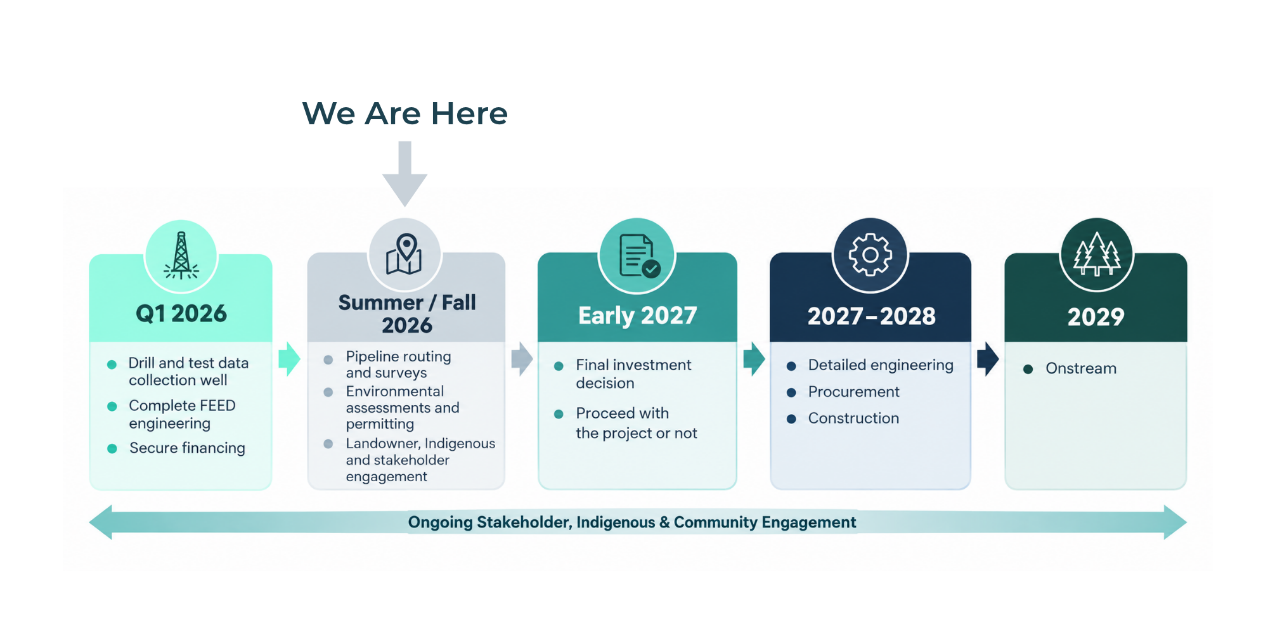
Engineering, environmental studies, land work, pipeline routing, permitting, and engagement are underway. An appraisal well was drilled in early 2026 to gather information about the proposed CO₂ storage formation. Timing remains subject to regulatory approvals and a final investment decision, which has not yet been made.
Discussions will cover proposed pipeline routing, land access, compensation, construction activities and land reclamation. Landowners’ knowledge of their properties will help inform planning, including measures to reduce disruption to farming and other land uses.
Landowners and neighbours can speak with the project team at open houses or contact us directly.
You do not need to have project infrastructure proposed on your property to ask questions or share your views.
North Star would capture carbon dioxide (CO₂) from the existing Meadow Lake Tribal Council (MLTC) Bioenergy Centre near Meadow Lake, Saskatchewan. A new 6-inch in diameter underground pipeline would transport the captured CO₂ from the Bioenergy Centre to the proposed geological storage site southwest of Meadow Lake, where the CO₂ would be safely and permanently stored more than one kilometre underground.
The proposed pipeline is approximately 34 kilometres long, although the final length will depend on the route selected. Before entering the pipeline, the captured CO₂ would be dried to remove water and help prevent internal corrosion, then compressed for safe transportation to the CO₂ storage site.
The pipeline route is not final. The project seeks to avoid or minimize impacts to sensitive areas, with crossing methods selected to suit site conditions and environmental and engineering requirements.
Surveying, environmental studies and discussions with landowners are underway to better understand conditions along the proposed route. Route selection will consider:
The CO₂ pipeline would be designed, constructed, and operated in accordance with applicable Saskatchewan regulatory requirements and CSA Z662, the Canadian standard for oil and gas pipeline systems, which includes several layers of protection.
The pipeline will be constructed using high-strength carbon steel selected for safe CO₂ transport. Welds would be inspected and the pipeline tested before it is placed into operation.
Flow and pressure would be continuously monitored at the pipeline inlet and outlet. Computer-based systems would compare operating information and alert operators to unexpected changes that could indicate a leak or another operating problem.
Valves would be installed at locations determined through detailed engineering. These valves would allow sections of the pipeline to be isolated during maintenance or in the unlikely event of an emergency.
The pipeline route would be regularly inspected for conditions such as erosion, ground movement, damage or unauthorized activity. The pipeline will also be designed to accommodate specialized internal inspection tools to assess its condition over time. A corrosion-protection system would help protect the buried steel pipeline from external corrosion.
The completed pipeline would undergo pressure testing and required inspections before CO₂ transportation begins.
Where the proposed pipeline crosses private land, the project team will work directly with affected landowners to discuss routing, property access, construction timing, and measures to reduce disruption to existing land uses.
Land agreements would set out land rights, access, temporary workspace, compensation and reclamation responsibilities, including how construction damage or crop loss would be addressed.
During construction, typical equipment may include excavators, trenchers, pipe-laying equipment, graders, welding equipment, and support vehicles.
Following construction, disturbed areas would be reclaimed. The permanent pipeline right-of-way would need to remain accessible for inspection and maintenance. Any restrictions on activities within the right-of-way would be explained and addressed in the land agreements.
CO₂ is not flammable or explosive, however, in the unlikely event that a release of CO₂ occurs from a pressurized pipeline, it can present safety hazards. High concentrations of CO₂ can affect breathing and cause serious harm, both through exposure to CO₂ itself and by displacing oxygen. CO₂ can accumulate in low-lying or enclosed areas.
The pipeline’s safety approach would include several layers of protection:
Prevention → Detection → Shutdown → Isolation → Response
Monitoring and control systems would help operators identify abnormal conditions, stop the supply of CO₂, and isolate affected pipeline sections if required. A detailed emergency response plan is being developed and will be in place before construction begins. Planning would include coordination with local first responders and emergency exercises before operations.
The pipeline will be buried underground with a minimum of 1.2m depth of cover, with greater depths used where required by design, crossing conditions, environmental conditions (such as frost line) or applicable requirements.
Pipeline construction is planned to start in late 2027 when the ground is frozen. The pipeline construction should be finished early 2028, with commissioning activities completed by mid-2028.
Carbon dioxide (CO₂) is a naturally occurring, colorless and odorless gas. Plants absorb it as they grow, and people breathe it out.
CO₂ is not flammable or explosive, but in the unlikely event that high concentrations of CO₂ are released in a short period of time, it can cause serious harm through exposure to CO₂ itself and by displacing oxygen. Releases from pressurized equipment can also create hazards.
For these reasons, CO₂ facilities and pipelines are designed with multiple layers of prevention, monitoring, and emergency response.
North Star’s proposed safety approach includes:
These measures would work together to reduce the likelihood of a release, detect potential problems, and support a timely response.
CO₂ behaves differently from natural gas. It will not ignite, but because concentrated CO₂ is heavier than air, it can collect in depressions or low-lying areas depending on terrain and weather conditions.
Emergency planning considers potential release scenarios, where CO₂ could travel and which areas could be affected. It would also address shutdown and isolation procedures, public notification, protective actions, and coordination with emergency responders.
Residences and other occupied buildings within an emergency planning zone will be identified, and appropriate emergency contact information will be confirmed so landowners and occupants can be contacted promptly in the unlikely event of an emergency.
The Emergency Response Plan will also include road and emergency access details and coordination with local emergency response organizations.
Past global CO₂ incidents demonstrate why careful design, maintenance, and emergency preparedness are essential.
In 2020, a CO₂ pipeline ruptured near Satartia, Mississippi, leading to evacuations and 45 people receiving hospital treatment. There were no deaths associated with this incident (or any CO₂ pipeline leaks prior to Satartia). The incident demonstrates why release assessment, public notification, and emergency preparedness matter.
Satartia involved a pipeline release due to a landslide and shifting soil, rather than a failure of an underground storage formation. Each requires specific safeguards.
Trees absorb CO₂ as they grow. Residual wood from sawmill operations is already used at the Meadow Lake Tribal Council (MLTC) Bioenergy Centre to generate renewable heat and power, releasing carbon originally absorbed by trees. This is called biogenic CO₂.
North Star would capture this CO₂, transport it by pipeline and permanently store it deep underground, keeping it from returning to the atmosphere. This process is known as bioenergy with carbon capture and storage, or “BECCS”.
A carbon dioxide removal (CDR) credit represents one metric tonne of verified net CO₂ removed from the atmosphere, with durable storage.
For North Star, CDR credits would reflect the CO₂ permanently stored minus relevant lifecycle emissions, including those associated with biomass supply, capture, transportation, and storage. This is called “net removal”.
The resulting CDR would need to meet the applicable carbon-removal standard and methodology and undergo independent verification before CDR credits could be issued.
Companies and organizations can purchase durable carbon removal credits to help address emissions that are difficult to eliminate directly. Carbon removal complements efforts to reduce emissions.
Credit purchases help fund carbon removal projects. Long-term agreements give developers greater certainty of future revenue.
Revenue from CDR credit sales would help fund the capture, transportation, storage, and monitoring needed to deliver verified carbon dioxide removal.
It would also create an additional revenue stream linked to the region’s existing forestry and bioenergy system, which could help strengthen its long-term economic resilience.
North Star has already secured a long-term customer for future carbon dioxide removal. Microsoft has agreed to purchase credits representing 626,000 tonnes of durable CO₂ removal from the project over 15 years.
Issued credits are recorded in a registry that tracks their ownership and use. When a buyer uses a credit toward a climate claim, it is “retired” or taken out of circulation so that it cannot be sold and used again by another buyer.
North Star’s carbon credits will be registered on a third-party registry (Puro.earth), who will publish quantitative results upon credit issuance (net carbon credits generated, issuance data, and verification status) when they are generated during operations.
No additional forest harvesting is proposed specifically to supply North Star.
The project would capture CO₂ from residual wood waste material already used by the MLTC Bioenergy Centre as part of the region’s existing forestry and sawmill operations. North Star adds carbon capture to that existing system.
No. Credits differ in whether they represent emissions reductions or carbon removal, how the benefit is calculated and verified, and how long carbon remains stored. For North Star, credible credits would depend on measured net removal, verified storage, and ongoing monitoring.
North Star proposes to store CO₂ in deep porous rock more than 1 kilometre underground. The tiny spaces between grains of rock provide room for the CO₂, while thick layers of low-permeability rock above the storage formation act as seals that restrict upward movement.
Before a storage project can operate, the geology must be assessed to understand:
North Star has already drilled and tested an appraisal well at the proposed storage site to collect site-specific geological information.
Several mechanisms help keep CO₂ within a suitable storage formation:
The injection well would include steel casing and cement designed to isolate it from surrounding formations and groundwater. Well integrity testing and monitoring would help assess whether these barriers are performing as intended.
Injection would be managed within site-specific pressure limits to protect the well, storage formation, and caprock. Unexpected pressure changes would be investigated, with injection adjusted or suspended if needed.
North Star is developing a Measurement, Monitoring and Verification (MMV) program to establish baseline conditions before injection and monitor storage performance over time. MMV answers three questions:
Monitoring methods can include underground pressure and temperature measurements, well-integrity monitoring, seismic imaging, and surface and near-surface measurements. The methods selected for North Star would reflect site conditions, identified risks, and regulatory requirements.
Monitoring results would be compared with baseline conditions and computer-model predictions. Unexpected changes would be investigated to determine their cause and whether corrective action is needed.
Monitoring would continue after CO₂ injection ends to verify that the storage system is performing as intended, with the monitoring scope and duration established through the project’s closure plan and applicable regulatory requirements.
North Star is a new project, but geological CO₂ storage is not new to Saskatchewan.
The Petroleum Technology Research Centre’s Aquistore project near Estevan has been injecting and monitoring CO₂ in a deep saline formation since 2015. As of March 2025, approximately 620,000 tonnes of CO₂ had been stored there. Its monitoring program includes seismic monitoring and other subsurface and near-surface techniques.
Aquistore, together with research and operating experience at Weyburn-Midale, where CO₂ is used for enhanced oil recovery, provides a significant body of local scientific and operating knowledge that newer projects can learn from, while recognizing that each storage site has different geological conditions.
Induced seismicity refers to seismic activity caused by human activities that change pressure or stress underground. This can occur with several types of subsurface activity, including fluid injection, wastewater disposal, geothermal development and, in some circumstances, geological CO₂ storage.
Most induced seismic events associated with subsurface injections are very small and may only be detected by sensitive monitoring equipment. Whether seismicity occurs depends heavily on the geology, existing faults, injection rate and pressure, and how the storage reservoir responds to injection.
CO₂ is injected into the tiny pore spaces within deep, porous rock. As CO₂ is added to the formation, the pressure within the reservoir can change. If increased pressure reaches a fault that is already under stress, it could cause the fault to move and create a seismic event.
Understanding the geology before injection begins and carefully controlling reservoir pressure during operations are therefore important parts of designing a geological CO₂ storage project.
No. Geological CO₂ storage is designed to inject CO₂ into an underground formation that already has pore space capable of accepting the CO₂. The objective is not to fracture the rock. Injection pressures would be established through site-specific assessment and regulatory review to protect the well, storage formation, and overlying sealing rock.
1. Understand the geology: Geological, well, and seismic information is used to assess the storage formation, caprock, faults, and surrounding rock, including formations beneath the proposed storage reservoir.
2. Select a suitable storage site: Site assessment considers CO₂ storage capacity, how readily the formation accepts CO₂, long-term containment, and whether pressure changes caused by injection could reach nearby faults.
3. Manage injection pressure: CO₂ injection rates and pressures are managed within approved operating limits, informed by site-specific geological information and modelling.
4. Monitor the reservoir: Pressure and seismic monitoring can help identify changes underground. Results can be compared with baseline conditions and model predictions to assess whether the reservoir is behaving as expected.
5. Adjust operations if needed: Operating and monitoring plans can define conditions that trigger investigation or changes to injection. Responses may include additional monitoring, reducing injection rates or pressures, or suspending injection while the cause is assessed.
Saskatchewan requires authorization for geological CO₂ storage projects. Project-specific technical information is provided for regulatory review and approvals, and the establishment of operating conditions.
Aquistore, located near Estevan, has been injecting and monitoring CO₂ in a deep saline formation since 2015. Its Measurement, Monitoring and Verification (MMV) program includes passive seismic monitoring, which listens for seismic activity underground.
In its 2024–2025 annual report, the Petroleum Technology Research Centre reported that approximately 620,000 tonnes of CO₂ had been stored by the end of March 2025, and that ongoing passive seismic monitoring had not detected induced seismicity related to CO₂ injection at the site.
North Star’s proposed CO₂ storage formation is more than one kilometre underground. An appraisal well has already been drilled and tested to collect site-specific information about the proposed storage formation. North Star is also developing a MMV program to establish baseline conditions, monitor the behavior of injected CO₂, and verify storage performance.
A site-specific assessment determines potential pressure communication with faults, appropriate injection pressures and operating limits, and suitable seismic monitoring and response procedures.
Community investment supports initiatives that benefit people living in the region. It can include funding, equipment, partnerships, sponsorships, employee volunteering or other practical assistance.
Examples include education and training, safety, youth activities, cultural programs, community facilities, health and wellness, and environmental initiatives.
The most useful investments respond to priorities identified by communities themselves.
A project can positively contribute to a region in several ways:
These contributions are connected, but each has a different purpose. Community investment is separate from compensation for land access or project impacts, and from measures required to prevent or address those impacts.
Potential priorities for discussion could include:
Education, scholarships, and skills development;
A community-informed approach starts with listening.
Discussions with local stakeholders, community organizations, Indigenous nations, municipalities, and residents can help identify existing initiatives, gaps in support, and opportunities for lasting benefit.
Clear selection criteria would explain how decisions are made. Working with established local organizations could also help support initiatives that communities already value.
As North Star develops, community discussions will help identify where the project could contribute to local priorities alongside employment, business opportunities, and Indigenous participation. Any future community investment program will explain what support is available, who can apply and when, and how decisions will be made.
Community members and organizations can share priorities and suggestions with the project team. Ideas will help inform planning, although funding cannot be guaranteed.
North Star would add carbon capture to the existing Meadow Lake Tribal Council (MLTC) Bioenergy Centre near Meadow Lake, Saskatchewan. The proposed project includes three main components:
Work would include foundations and installation of capture equipment, piping and electrical systems, using cranes, trucks, and other construction equipment. Connections to the Bioenergy Centre would be coordinated with its operations.
Work would include preparing temporary workspace, storing topsoil where present, excavating a trench, welding and inspecting pipe, placing it underground, and replacing soil. Some crossings or sensitive areas may use directional drilling, depending on site conditions.
Construction would move along the route in stages. Impacted landowners would be contacted about access, timing, workspace, and reclamation.
The appraisal well has been drilled and tested and is currently suspended. If the project proceeds, it would be converted to an injection well, with control and monitoring equipment installed. Temporary equipment and vehicles would be needed during this work.
During construction, nearby residents may notice:
Planning would identify and address potential impacts related to traffic, dust, farming activities, and other local concerns.
Work hours, access arrangements and activities that could affect neighbours would be communicated as plans are finalized.
Disturbed areas would be reclaimed following construction, with measures appropriate to the land use and site conditions. On agricultural land, this may include replacing topsoil, addressing compaction, and restoring disturbed areas for farming.
The pipeline right-of-way would remain accessible (clear of trees, and structures) for inspection and maintenance. Landowners would receive guidance on activities above or near the pipeline. Permanent facilities and access areas would remain during operations.
Once construction and testing are complete, the project moves into regular operation.
At the Bioenergy Centre: Carbon capture equipment would operate alongside the existing bioenergy facility. The captured CO₂ would be dried and compressed before entering the pipeline. Equipment would require routine inspection and maintenance, with noise management considered in the detailed design.
Along the pipeline: The pipeline would be buried, with surface features such as markers and access to valves where required. Pressure and flow would be monitored, and the route would be inspected and maintained. Excavation near the pipeline would require appropriate locating and safe-work procedures.
At the storage wellsite: CO₂ would enter the injection well through equipment that controls its flow and pressure. The well and storage system would be monitored to assess operating conditions and storage performance. Personnel would visit for inspections, maintenance, testing and other operating activities. Staffing, vehicle movements and the final equipment layout would be confirmed through detailed planning.
Operations generally involve much less traffic and temporary equipment than construction. Maintenance, deliveries and well testing could occasionally increase activity. Neighbours would be informed of planned work that could affect them in advance.
Ending injection means that no more CO₂ is being added to the storage formation. The stored CO₂ would remain underground.
The project would then move through monitoring, well closure, and reclamation activities under an approved closure plan and applicable regulatory requirements.
Monitoring after injection helps assess whether the storage system is performing as expected. It can provide information about underground pressure, the location and movement of stored CO₂, and the condition of wells.
Results would be compared with earlier measurements and model predictions to help determine whether further monitoring or corrective work is needed.
After injection ends, underground pressure would generally begin to settle as fluids redistribute within the formation. The timing and extent of these changes depend on the site’s geology.
The CO₂ would remain contained by the storage formation and its sealing rock layers. Over time, some CO₂ may also become trapped within tiny rock spaces, dissolve in formation water (which does not interact with groundwater or drinking water) or react with minerals.
These processes occur at different rates. Monitoring and geological assessment help build an understanding of how the storage system behaves over time.
The monitoring scope and duration would be established through North Star’s closure plan and applicable regulatory requirements.
The time needed will depend on site conditions, monitoring results, and the evidence required to demonstrate that storage is performing as intended.
When the CO₂ injection well is no longer needed, it would be permanently closed using an approved process, which involves installing barriers, such as cement plugs, to seal the well and isolate underground formations. The closure work would need to meet applicable requirements and be documented.
Monitoring wells may remain in use for a period after injection ends, depending on the monitoring plan.
Equipment that is no longer needed would be removed or decommissioned under the closure plan.
Disturbed land would be reclaimed to meet applicable requirements and the agreed land use. This could include removing foundations where required, restoring soil and drainage, and re-establishing vegetation.
Pipeline decommissioning arrangements would be established through thorough closure planning, applicable regulatory requirements, and land agreements.
Unexpected results would be investigated to understand their cause and whether they are related to the stored CO₂ or project infrastructure. Depending on the findings, responses could include additional measurements, well testing, repairs or other corrective work.
The closure and monitoring plans would also address regulatory reporting and communication with landowners and any other potentially impacted stakeholders.
The closure plan and applicable legal requirements would establish responsibility for monitoring, maintenance, corrective work and reporting.
Any future transfer of responsibility would require the relevant legal and regulatory conditions to be met. It should not be assumed that responsibility automatically transfers when injection ends.
Planning for closure is part of planning the project. North Star is developing a monitoring, measurement, and verification (MMV) program that includes monitoring during operations and following closure. Detailed arrangements for closing wells and facilities, reclaiming land, and managing long-term responsibilities would be established through extensive closure planning and applicable requirements.
Community members are encouraged to ask questions about these arrangements as the project develops.